The Texture Walk: Meeting a Familiar Room Through Touch
A texture walk helps you notice the surfaces in a familiar room and describe their details clearly, without turning touch into a rating or a hunt.
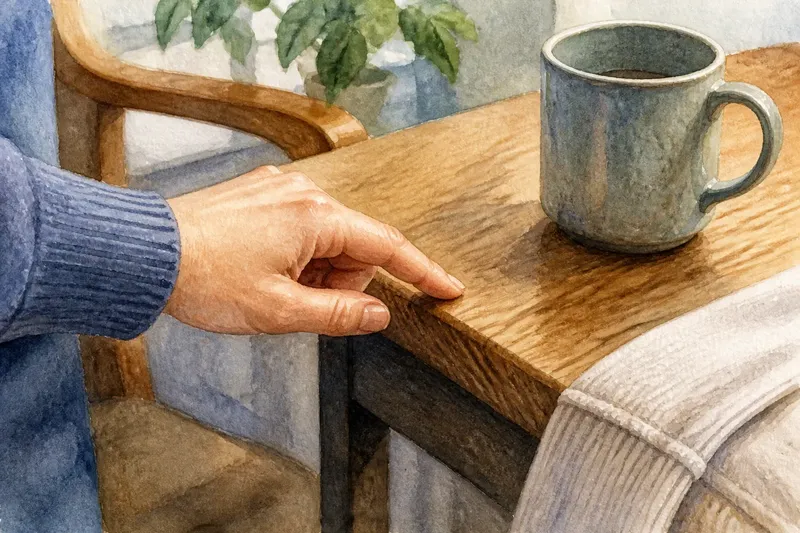
A texture walk can reveal how much a familiar room changes from one surface to the next. As you move among safe, everyday materials, notice temperature, resistance, grain, and edges; these details can make ordinary contact easier to describe.
The exercise is not a contest to find unusual textures. Treat it as a close look at how materials meet your hand. A wooden desk, a cotton sleeve, and a ceramic mug offer different kinds of information, even when none feels remarkable.
What can you notice on a texture walk?
Start with one stable object and touch it lightly, if it is safe to do so. Notice whether the surface feels cool or warm, smooth or ridged, firm or yielding. Then move your hand a little and see whether the sensation changes at an edge, seam, or worn patch.
Use plain words rather than searching for an exact technical term. “The cushion gives under my palm” describes contact. “The cushion is comfortable” describes your response to it. Both may be true, but separating them helps you see what comes from the material and what comes from your reaction.
Say you are seated at a desk with a ceramic mug nearby. You rest one fingertip on the desk’s edge, notice that the top feels smooth and the underside slightly ridged, then touch the mug’s cool outer wall. The resulting description is specific: the desk changes texture at its edge, while the mug feels cool and firm. No ranking is needed to distinguish them.
How do you choose surfaces to touch?
Choose familiar, stationary objects that appear safe: a wooden chair arm, a cotton sleeve, or a clean ceramic mug. You do not need to cover the room. Following a few surfaces closely can show more than hurriedly touching everything within reach.
Some materials are better observed without contact. Skip objects that are sharp, unstable, dirty, damaged, or unfamiliar, and do not handle unknown substances. You can look at a surface instead, choose a safer nearby object, or stop. For items with special handling instructions, follow the label or ask a qualified professional when appropriate.
What changes can you track without judging the surface?
Describe where and how contact shifts. A fabric may feel soft across its main panel but raised along a seam. A tabletop may feel smooth on top and rough beneath its edge. Naming the location makes the observation useful without turning it into a verdict about the object.
Words such as “best,” “gross,” and “perfect” express evaluation. If one comes to mind, you do not need to push it away. Add a detail that your hand can locate: “I dislike this rough edge; it catches slightly against my fingertip.” The reaction remains yours, while the second phrase reports the contact.
What should you do when a texture distracts you?
If a surface feels unpleasant, stop touching it and move to another one or end the exercise. There is no benefit in enduring discomfort. If you notice yourself repeatedly checking whether the sensation has changed, describe it once in neutral terms—“scratchy at the seam,” for instance—and shift your attention elsewhere.
A texture walk is for ordinary, safe contact, not for investigating a persistent or concerning sensation. If a sensation raises a health concern or causes ongoing distress, seek advice from a qualified professional rather than relying on a mindfulness exercise.
What questions do people ask about a texture walk?
Do you need to close your eyes?
No. Keep your eyes open if that helps you move safely or feels more comfortable. You can attend to touch while looking at the object in front of you.
Should you touch every surface in the room?
No. Choose a few familiar materials and leave uncertain or uncomfortable objects alone. Looking closely is also a way to notice texture without touching it.
What if you cannot find the right word?
Use a simple contrast such as smooth and rough, warm and cool, or firm and yielding. You can also locate the sensation—“a ridge beneath my thumb”—without naming the entire surface.
When should you stop the walk?
Stop when you have noticed enough, when the exercise becomes distracting, or whenever a surface feels unsafe or uncomfortable. There is no required duration or number of objects.
How can you turn a reaction into a clear description?
- If you notice yourself calling a surface “nice,” then identify a feature such as warmth or softness; if no feature comes to mind, move on without forcing a description.
- If you call a surface “bad,” then locate the contact, such as dampness or prickliness; if touching it is uncomfortable, stop and choose a different surface.
- If the texture seems to change, then note where the change occurs, such as at a seam or edge; if you cannot locate a change, describe the surface as a whole.
- If you start guessing an object’s story from its feel, then return to what your hand detects; if that remains distracting, shift to a visually observed surface.
- If you catch yourself ranking two materials, then describe each separately; if comparison keeps pulling your attention away, focus on just one.
- If a reaction stays present, then acknowledge it without treating it as a verdict; if it grows uncomfortable, end the walk.
When you finish, carry one clear detail with you: the cool wall of a mug, a raised weave, or a change in grain at a chair’s edge. A texture walk does not need a score or a discovery to be useful. The phrase “texture walk” can simply mean taking time to notice how familiar surfaces differ under your hand.