A Quiet Boundary for the Last Ten Minutes of the Day
A quiet boundary for the last ten minutes of the day helps you park unfinished work, protect personal time, and leave a clear note for later.
A quiet boundary for the last ten minutes of the day can stop unfinished work from taking over personal time. Choose a clear stopping cue, record what needs attention later, and close the work period without pretending every task is done.
What does this boundary protect?
A boundary is a limit around what you will do or attend to. In this case, it separates obligations from the next stretch of time you want to use differently. It does not mean every responsibility is complete or that you cannot respond to an urgent need.
Decide what the boundary means in practice: when your cue arrives, stop adding new tasks; after your closing action, leave the remaining work where it is until you intend to return. An unfinished task can matter without requiring your attention at every moment.
Personal time might mean making dinner, caring for someone, reading, resting, or sitting without a screen. You do not need to earn the transition by choosing a special activity. The boundary protects the change in attention, not a particular kind of leisure.
How do you choose a stopping cue?
Pick a signal that is easy to notice and already connected to the end of a work period or household task. A cue is a prompt to pause, not an order to rush. Use one signal rather than several reminders competing for your attention.
- If a calendar alert is easy to notice, label it “close the day”; if alerts interrupt calls, use a transition you can observe instead.
- If a scheduled work block ends reliably, use its end as the cue; if your schedule shifts, choose a task transition.
- If putting away a tool marks the end of a household task, use that action; if it happens unpredictably, choose a more reliable signal.
- If you usually hear a familiar clock chime, use it; if you are often elsewhere, do not depend on it.
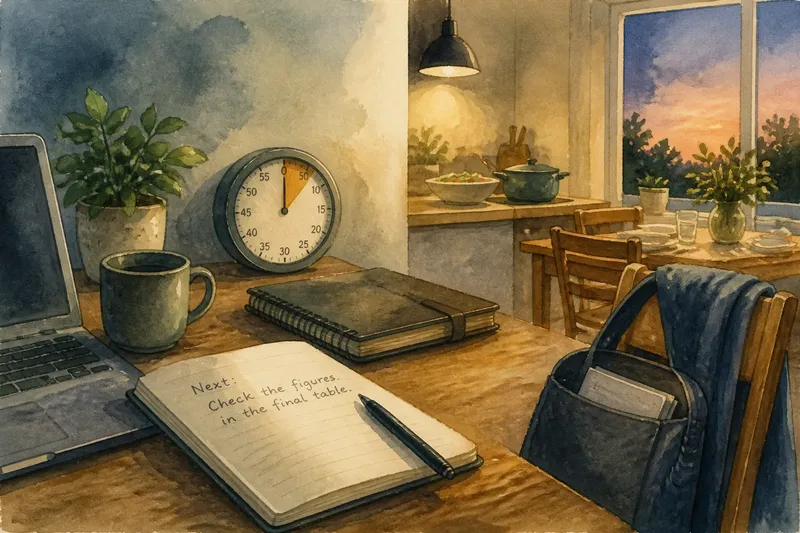
Say you work at a kitchen table and need it for dinner. Your starting point is a notebook, an unfinished task list, and a final planned work block. When that block ends, you put away the notebook and leave the table clear for food preparation. The visible change marks work as paused, even though the list still has unfinished items.
What closing action helps you resume later?
Choose one small action that leaves a useful signal for your future self. It should close the work period, not start another one. Depending on the task, you could write a next-action note, close a document, put materials in their usual place, or move to another chair.
For a task with several details, write the task, the next concrete action, and any item you will need. “Continue the draft” gives little direction; “open the draft and revise the shipping section” identifies where to begin. Keep the note brief so making it does not become a planning session.
Imagine you are preparing a report and have not checked its final table. When your cue arrives, you close the file and write, “Next: check the figures in the final table.” Your starting point is the open report and an unfinished check; your action is to leave one specific note; the result is a clear place to resume, while the report remains unfinished.
What questions come up about a quiet boundary?
Should the cue be a clock time?
It can be, if your schedule is steady and a calendar alert is easy to notice. If your days vary, a recurring transition may be more practical than a fixed hour.
What if I have no private workspace?
Use an action suited to a shared space, such as closing a notebook or putting work materials in a bag. The signal can be small and does not require a dedicated room.
Should I write down every unfinished task?
No. Record only what you need to resume without reconstructing the whole situation. A specific next action can be more useful than copying an entire task list.
What if the routine starts to feel like another chore?
Remove any part that has grown beyond its purpose. If the cue or action still feels burdensome, change it to something simpler, such as closing a notebook and leaving it in its usual place.
How can you tell whether the boundary fits?
Look for a practical sign: you stop opening new work, know what to do next, or find it easier to choose how to spend the evening. If none of those changes appears, adjust the cue or the closing action rather than adding more steps.
The main search phrase, quiet boundary for the last ten minutes of the day, describes a way to mark unfinished work as paused, not erased. Leave yourself a usable next action, and let the rest of the evening begin without carrying every task into it.